No cook can slice to perfection without a sharp, well-balanced knife. When it comes to precision and craftsmanship, few blades can rival the legacy of Japanese knives. Originally forged in the fires of samurai weaponry, Japanese knives are renowned for their sharp edges, light feel and razor-thin precision. You simply can’t master the art of fine slicing without one.
But even the sharpest tool needs care to stay legendary. Working with a dull blade means pushing harder, slipping more often and ending up with squashed tomatoes instead of clean slices. Not to mention putting yourself through risk of injury. When it comes to restoring the fine, precise edge these Eastern tools are famous for, sharpening on waterstones is the gold standard. However, the process takes a bit of time and precision.
That said, you don’t need to reach for the stones every time the blade needs a bit of TLC. When your Gyuto starts to lose its glide through carrots or onions, a quick touch-up with a ceramic rod can bring it right back to its former glory. Between sharpening sessions, a honing steel knife sharpener can help maintain your blade’s alignment. With a few gentle strokes before each use, you can keep the knife in peak condition and delay the need for a full resharpening.
Types of Honing Rods
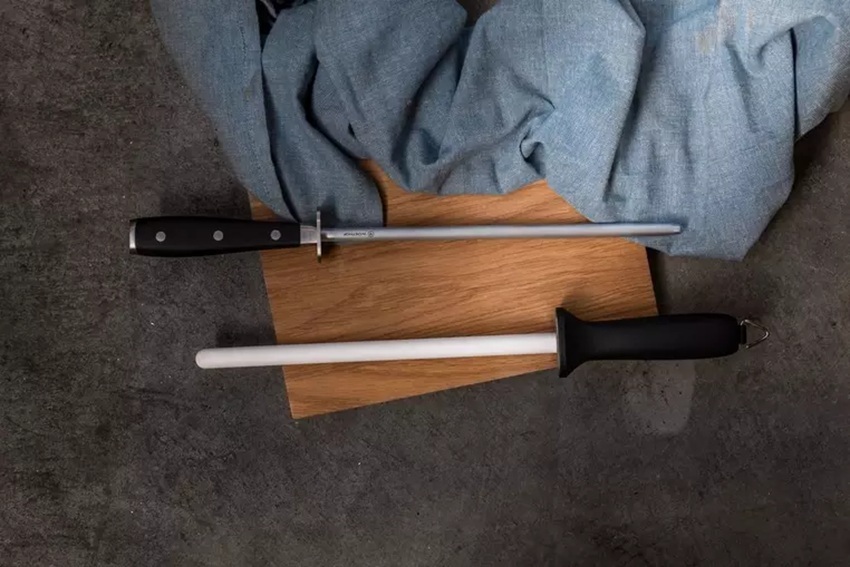
As already mentioned, a reliable honing steel knife sharpener is your daily blade maintenance tool, so you’d better invest in one. But before making a purchase, it’s worth knowing that honing rods come in a variety of materials, with stainless steel, ceramic and diamond-coated models being the most common ones.
Ceramic
Ceramic sharpening rods are among the most popular kitchen tools for maintaining a razor-sharp edge. Crafted from finely ground natural or synthetic ceramic materials (which are fired at high temperatures to create a hard, dense surface), these tools are incredibly hard. In fact, they’re harder than most knife steels. Despite their hardness, ceramic sharpening rods are gentle on blades. Unlike rough or coarse sharpening tools, these remove only tiny amounts of metal with each stroke, which is enough to refine the edge without chipping or damaging it.
This combination of extreme hardness and gentle abrasion makes ceramic rods ideal for maintaining the delicate, thin edges typical of Japanese knives. Ceramic outperforms diamond and coarse metal steels, which can be too harsh on fine Japanese blades. Therefore, you might consider getting a ceramic sharpening rod instead.
Stainless Steel
While ceramic rods are a favourite for preserving delicate edges, stainless steel honing rods are another popular option. They are best suited for German or general-purpose kitchen knives. You might find them in two styles, smooth and grooved. Grooved stainless steel rods work well for softer, Western-style knives made from more forgiving steel. However, they can be too aggressive for harder Japanese blades and may cause micro-chips or edge rolling.
Smooth stainless steel rods, on the other hand, offer gentler honing. They realign the edge without removing material and are a safer choice if you’re looking for something less abrasive. But even smooth rods may lack the fine control and hardness needed to properly maintain high-end Japanese knives, so you might want to skip the steel and stick with ceramic.
Diamond-Coated Surfaces
Another popular option to consider is honing rods with diamond-coated surfaces. These rods are coated with tiny diamond particles – one of the hardest naturally occurring substances. This makes them incredibly abrasive and effective at quickly sharpening even very dull or hard steel blades. Unlike ceramic or steel rods, diamond-coated rods can actually remove metal, bridging the gap between honing and sharpening.
However, powerful, diamond-coated rods should be used with care, especially on delicate Japanese knives. When used too frequently or improperly, their aggressive action can wear down delicate knife edges faster. This said, you don’t always need to skip them. If you own an Eastern edge, it’s best to reserve diamond rods for rare, restorative uses only. Most of the time, you want to stick to ceramic steels or professional sharpening to keep the edge.
When to Hone and When to Stone
Ceramic, stainless steel (smooth or grooved) and diamond-coated rods are suited for different blade types and needs. But no matter which material you choose, what really matters is knowing when to hone and when it’s time for a full sharpening session.
For instance, if you own a Usuba, Deba, Yanagiba, or other Kataba knife characterised by their single-bevel edge and hard, thin steel, it’s important to avoid using honing rods altogether. Instead, they must be maintained using whetstones. Only this way can you preserve their precise edge and protect the delicate bevel.
Although single-bevel knives require whetstones, other blades can benefit from regular use of a honing rod. Double-bevel knives like Gyuto, Santoku, Petty knives, and most Western-style knives can all respond well to honing.
Related Posts
 How to Choose a Knife Sharpener: Keep Your Knives Razor-Sharp
 Custom Retail Bags – A Unique Promotion Opportunity for Your Business
 The Unique Benefits of Upright Fridge Freezers for Commercial Kitchens
 Choosing the Right Travel Backpack for Your Globetrotting Adventures
 Unique Valentine’s Day Hairstyle